TUSNACO
The US Navy Always Chickens Out
Trump’s decision to open talks with Iran, after threatening “massive destruction” has been treated as another example of TACO (Trump Always Chickens Out), focusing on the risks of a long ground war. In reality, the risks are much more immediate and have grave implications for the US as a global power. That can be summed up by replacing “Trump” with “The US Navy”, to give TUSNACO.
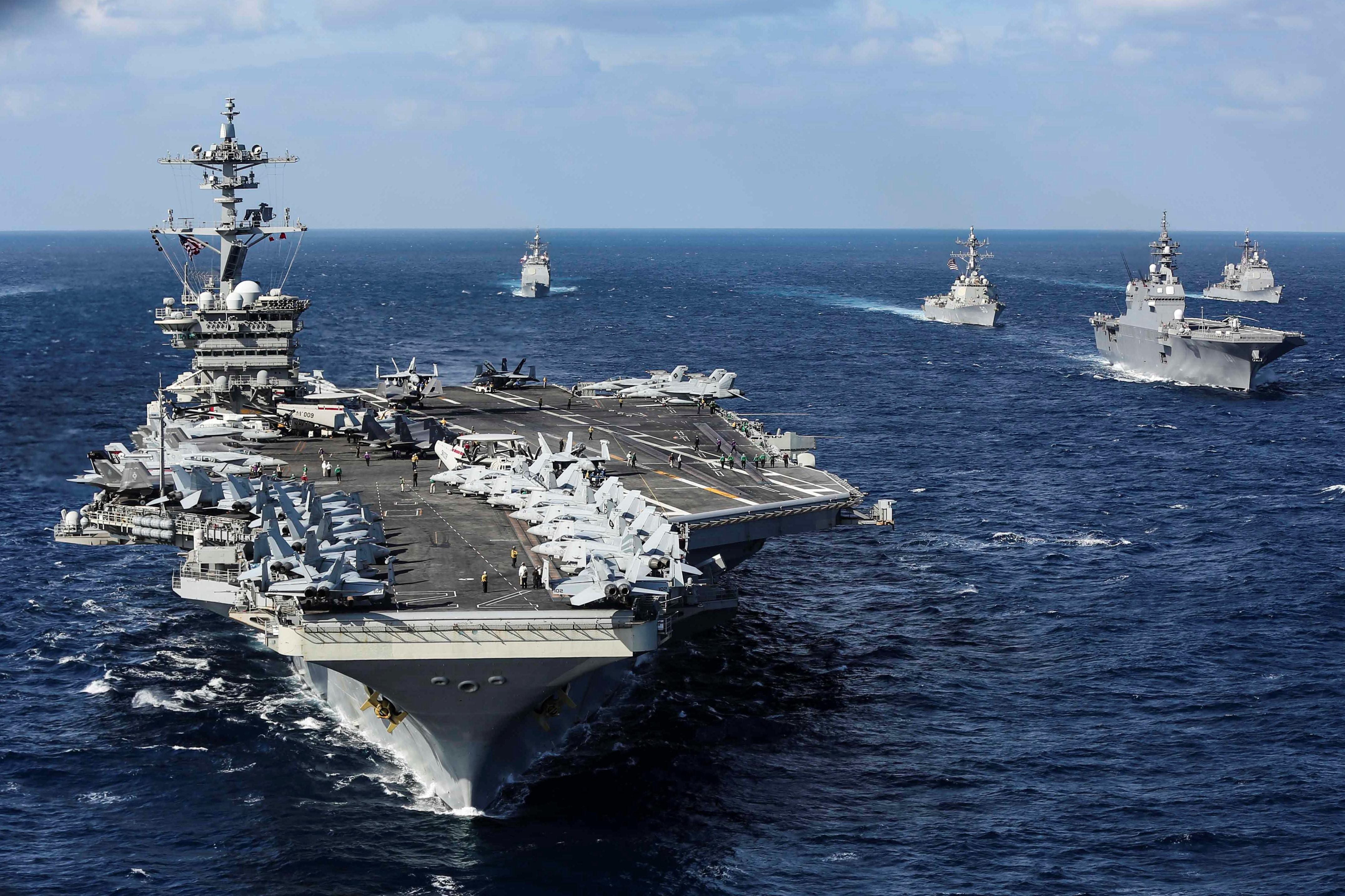
To awe the Iranians into submission, Trump sent a “massive armada” consisting of an aircraft carrier (USS Abraham Lincoln) along with four or five major escorts (destroyers and guided missile cruisers) and support vessels. The escorts are critical. They provide missile defence using AEGIS and Sea Sparrow systems, and once their interceptor stocks fall to low levels they must withdraw to be replaced or rearmed.
This creates an arithmetic problem. A Hobart-class destroyer has 48 blocks each capable of carrying one AEGIS controlled SM-2 or SM-6 interceptors. Alternatively, each block can carry four Sea Sparrows, but these are less capable.
Standard USN doctrine calls for the use of two defensive missiles against each incoming missile. On the assumption of 100 usable missiles per escort, that’s 50 defensive actions per escort or 200-250 in total. No one knows how many missiles Iran has available, but typical estimates suggest at least 3000, of which 1000 or more could be used in anti-ship capacity. Even assuming successful air attacks on launch sites, use of aircraft against missiles etc, hundreds of missiles will pose a threat, and at least some of them will cause enough damage to force escorts to withdraw.
A carrier-based bombing campaign couldn’t be sustained for even ten days without exhausting the carrier group’s defences, and requiring the USN “declare victory and go home” That’s TUSNACO, as happened in two failed campaigns against the (much weaker) Houthis.
But that’s the good outcome for the USN. There’s a substantial risk of a catastrophic loss of a capital ship or even the Abraham Lincoln itself. The symbolism would be disastrous in any case, but the name of the ship would make parallels to Russia’s loss of the Moskva irresistible.
Both sides can count. To the extent that he had a plan, Trump presumably hoped that the threat of the armada would cow the regime into submission or energise the democratic resistance into revolt (he doesn’t care about them of course, and it’s unlikely many Iranians like Trump even as the enemy of their enemy). Once that didn’t happen, the armada wasn’t so much a threat as a hostage. Alternatives like a high-level bombing attack are off the the table as long as a US fleet remains in missile range of Iran.
The bigger picture here is that the USN has ceased to be the irresistible instrument of power projection it was long assumed to be. Any littoral nation prepared to lay out a billion dollars or so can buy hundreds of anti-ship missiles at a few million dollars each. That’s enough to make it very risky for ships to operate within 1000km of the coast, which is about the maximum range within which carrier-based planes can operate a sustained campaign.
That in turn has implications for the US as a military superpower. The USN is, on many measures, bigger than all the other navies in the world combined, but this is now a stranded asset. There’s nothing like this imbalance in terms of land forces. Both China and Europe (including Ukraine) have much larger land forces: more troops, more tanks, more artillery and more drones. The USAF is big, but highly dependent on overseas bases. Nuclear weapons are another matter, but numbers cease to be relevant once you have the capacity to destroy the world many times over.
Mental habits conditioned by decades of US supremacy will take a long time to change. But the sooner Australians start rethinking our reliance on a declining power, the better.
Follow me on Bluesky or Mastodon
Read my comic book presentation of The Perils of Privatisation. Paid subscribers get a free physical copy.
Read my newsletter
This lesson has always been there for the Navy to learn...there was an exercise in 2002 as a precursor to the Iraq War called Millenium Challenge 2002. The "enemy" commanded by General Paul K Riper launched a preemptive strike sinking most of the US Navy invasion fleet. Chastened by their defeat, the rules of engagement were altered, the sunken ships refloated and all "enemy" positions revealed. Naturally the US Navy won. See https://en.wikipedia.org/wiki/Millennium_Challenge_2002
Anything Iran can do, Taiwan can do better. And the Taiwanese have mountains for hiding missile launchers in caves. Many of these will of course be empty.