

COP28 deal confirms what Australia already knows: coal is out of vogue and out of time

My latest piece in The Conversation
At the COP28 climate summit in Dubai this week, nations agreed to “transition away” from coal, oil and gas . After 30 years of COP meetings, the world has finally committed to weaning itself from these carbon-based drivers of climate change.
As Climate Change Minister Chris Bowen told the media, the deal “sends a signal to the world’s markets, investors and businesses that this is the direction of travel for countries right around the world.”
This COP statement is the first to name and shame all carbon-based fuels driving the climate crisis – not just coal, which has been mentioned in previous COP agreements, but also oil and gas.
The deal is a collective global aspiration rather than a legally binding agreement. Even so, it should put an end to the idea that burning carbon – both in Australia and elsewhere – can continue on a significant scale beyond 2050.
Renewables on the rise
The statement on carbon-based fuels is significant, but largely symbolic. In Australia, coal as a fuel has long been on the way out. Improved domestic energy efficiency has reduced energy consumption, even as the economy has grown. Most of this has come at the expense of coal – a trend likely to continue as electricity generation moves further towards renewables.
As the below table shows, starting from a base of almost zero, solar and wind energy generation has risen at startling annual rates over the last decade: 30% for solar and 15% for wind. Although shares of total energy consumption are still fairly small, these growth rates imply solar and wind will generate more energy than coal by the end of the decade.
Australia’s consumption of oil, mostly in the form of imported petrol and diesel fuel, has remained largely steady over the past decade. Successive federal governments have dithered on the transition to electric vehicles. But if Australia is to get anywhere near the goal of net-zero emissions by 2050, it must now tackle the transport sector which in 2022 produced 19% of Australia’s emissions – more than half from passenger and light commercial vehicles.
Given the absence of a domestic motor vehicle industry in Australia, the current government’s inaction on electric vehicles is surprising. It appears driven in part by a fear of populist campaigns by the Coalition and others about the effects on motorists. Who could forget claims in 2019 by then-Prime Minister Scott Morrison that electric vehicles would “end the weekend […] It’s not going to tow your trailer. It’s not going to tow your boat. It’s not going to get you out to your favourite camping spot” – claims since proven to be incorrect.
Also in play is the political lobbying power of the retail motor industry, backed by foreign car manufacturers keen to maintain a market for their remaining supply of petrol-driven vehicles.
The myth of carbon capture and storage
The final text also called for the acceleration of “zero and low emission technologies”. Controversially, this includes removal technologies such as carbon capture and storage, which involves trapping, transporting and storing greenhouse gas emissions from facilities such as coal-fired power stations and gas plants.
The inclusion of this technology was criticised by many observers as a loophole which would allow polluting, inefficient industries to continue. But it is better understood as a symbolic sop to the coal, oil and gas industries, which have long pinned their hopes of staying in business on the idea of burying the carbon they emit.
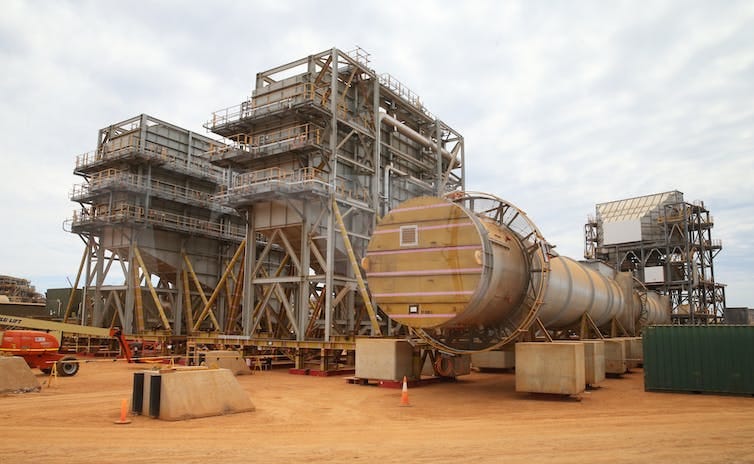
In reality, carbon capture and storage is a proven failure. The Gorgon gas project on the Barrow Island nature reserve, off Western Australia’s Pilbara coast, has stored barely a third of the targeted amount of carbon, forcing the proponents to buy carbon offsets instead (themselves a dubious option). Similarly, the only operating project capturing emissions from a coal-fired power plant, at Boundary Dam in Canada, has under-performed on carbon capture capacity by a huge margin.
So while carbon-capture is theoretically available as an option for new projects, in most cases it will prove either technically impossible or economically infeasible.
Read more: Electric utes can now power the weekend – and the work week
Australia faces a choice on energy exports
The COP28 statement’s call for an “urgent and equitable transition to renewable energy” presents opportunities for Australia. As Bowen acknowledged:
Australia wants to be a renewable energy powerhouse, we want to create the energy for ourselves, and for our region and for the world […] The COP decision today gives us a very good ecosystem in which to develop that plan.
But of course, “that plan” is totally inconsistent with the plans of the coal and gas industries, which are announcing new projects intended to operate well into the second half of this century. By backing these projects, the federal government is essentially betting that the aspirations of the COP28 statement will turn out to be just wishful thinking, and that Australia can profit from a world of catastrophic global heating.
Australia must now decide what kind of energy superpower it wants to be: the home of a sustainable future, or the last refuge of coal and gas extraction.
My Substack newsletter
Afternoon PJQ,
Good to see you contributing to the debate - any plans to return to Twitter/X? Your presence is missed there. What are your impressions of other platforms?
Re: COP28 deal confirms what Australia already knows: coal is out of vogue and out of time
'the world has finally committed to weaning itself from these carbon-based drivers of climate change'
Q- what are the ramifications of not going along with the commitment?
'Australia must now decide what kind of energy superpower it wants to be: the home of a sustainable future, or the last refuge of coal and gas extraction.'
'Given the absence of a domestic motor vehicle industry in Australia, the current government’s inaction on electric vehicles is surprising. It appears driven in part by a fear of populist campaigns by the Coalition and others about the effects on motorists.'
These paragraphs make it seem like you think that Australian governments have a choice. Well maybe a future one will in 2025 hopefully eg. minority Labor with many Teals/Indies, but at the moment isn't it a duopoly controlled by corporations & the Murdochracy ( I know you don't think they hold much sway, but many commentators do).
Be good to get your opinion on the 2party Lib/Lab mutualism.
Thanks, cheers
Yes, Australia will be the last refuge of coal and gas extraction. Approval of new mines? ~ no worries! Accountability for handouts such as for phantom CCS or planting some sort of trees, untended, somewhere? ~ Nope.
Addressing climate change and the health of the environment should be the most important issues driving the government and the economy. There should be investment in protecting mangroves (though I don't know if climate change has already kiboshed that) and trying to leave the lightest footprint possible in whatever tasks are carried out. Is it possible to build homes using hempcrete rather than concrete. If not, can hempcrete and other sustainable alternatives be developed further? The time to act really is now. The government needs to focus on building electric buses, running in dedicated bus lanes, to complement existing train and tram services. You need to get non-EVs off the roads as quickly as possible and why haven't fuel efficiency standards been legislated and implemented already?
Legislation also needs to be implemented on such matters as minimum building and occupancy standards. Why should people who are renting, have to make decisions about whether they can afford to heat or cool a room when there's no insulation? Lack of insulation of course means that heating and cooling appliances are switched on sooner and are used for a longer period of time.
As for Australia becoming an energy superpower? Perhaps not in this country when you're dealing with having to chuck more millions at dud projects like the sequel to the Snowy Hydro project; you can't resolve where power wires can be erected; and there's no plan concerning access to battery storage of solar energy.