Against apprenticeships
Australian political discussion regularly returns to the idea that the solution to our education and labour-market problems lies in “more apprenticeships”. It’s a rare point of consensus: unions love apprenticeships, business groups love them, and governments love them, regardless of party. Anthony Albanese, who pines for “an Australia that made things” loves them most of all.
The general line is familiar: too many young people are going to university, not enough are “learning a trade”, and the result is shortages of electricians, plumbers, and builders. The implication is that the old apprenticeship model is there waiting to be revived, if only we would stop pushing students towards university.
But nostalgia is rarely a sound basis for policy. And in this case it conceals a simple fact: the apprenticeship model that inspires this nostalgia has been in decline for at least two centuries. It continues to decline, not because of a lack of political will, but because the structure of work has changed beyond recognition.
Before about 1850, almost all job training was conducted through formal or informal apprenticeships. Universities were the preserve of a tiny elite. Most children received little formal schooling, and If you wanted to be a carpenter, cobbler, blacksmith, or cooper, you were taken on by a master, did whatever menial tasks were assigned, and gradually learned the craft. The only exceptions were there the “learned professions” law, medicine and clergy, and even law and medicine were mostly learned on the job.
But as the modern economy developed, professions shifted away from apprenticeship towards formal education. Law and medicine moved first, followed by engineering, architecture, and the sciences. By the early twentieth century, university study was becoming the primary route into almost all higher-skill occupations. “Placements” and “internships” survived as part of the transition from education to work, but they were supplements to classroom-based training.
Female-dominated fields such as teaching, nursing, and social work followed somewhat later. This was partly because their lower status they were slower to professionalise and partly because the expansion of secondary and tertiary education for women came later. By the time these fields were fully professionalised, apprenticeships were no longer the default model for any profession.
Meanwhile as the structure of the economy shifted towards the service sector, reliance on school and university education. Only a few traditional male trades, and a small number of mostly female ones such as hairdressing, retained a formal apprenticeship route. Even in these cases, however, the model was fraying by the latetwentieth century. Completion rates have been persistently low for decades. Gender inequality within apprenticeships has remained extreme.
Large public employers—railways, electricity utilities, Defence—had historically absorbed and trained many apprentices, but the wave of privatisations and corporatisations from the 1980s onwards saw much of this capacity disappear. As old trades declined with the collapse of large-scale manufacturing, the apprenticeship pipeline shrank further.
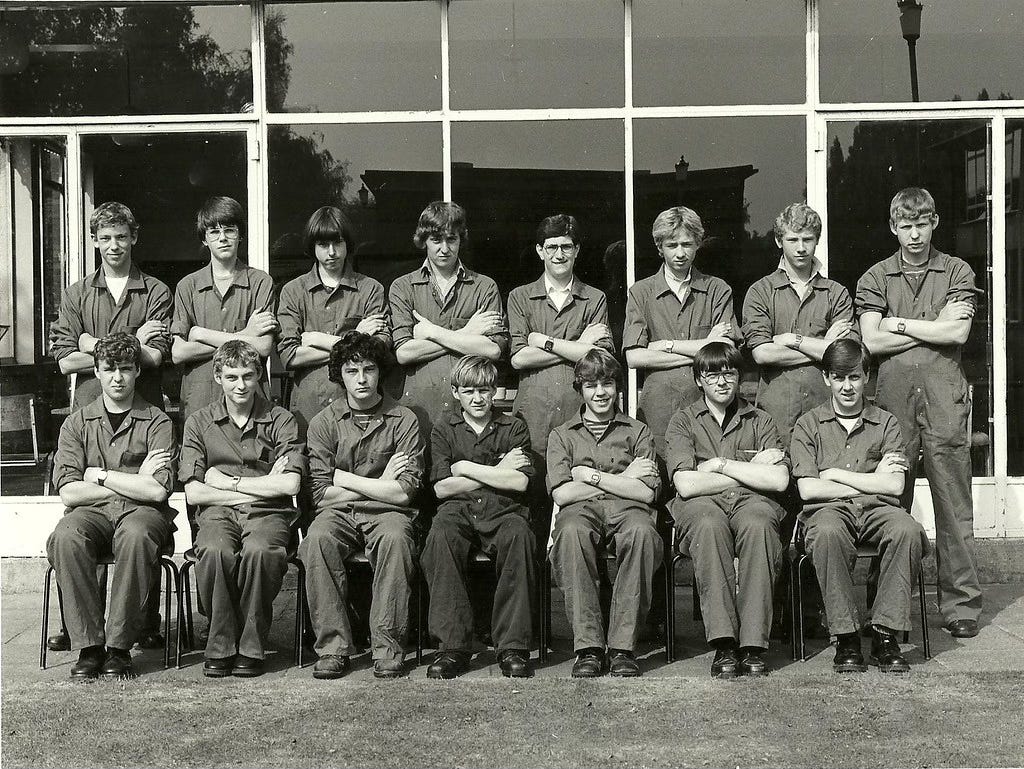
The classic apprenticeship model: UK Railway works apprentices in 1983 Flickr.com
Meanwhile, new technical occupations emerged—particularly in information technology—that skipped the apprenticeship model entirely. Programmers, network technicians, cybersecurity specialists and data analysts all developed outside the traditional master-apprentice structure. Employers in these fields expected applicants to have some mix of university study, private training, vendor certifications, and on-the-job learning. No one proposed a four-year indenture to a master programmer.
Even within the traditional trades themselves, the apprenticeship model has become increasingly hybridised. TAFE and VET providers now deliver a large share of the actual instruction, with employers sometimes functioning as little more than providers of work experience. The result is an awkward compromise between a medieval training structure and a modern curriculum.
Yet the political rhetoric has scarcely changed. The debate still assumes a neat dichotomy: university on one side, “vocational education” on the other. This framing is both misleading and unhelpful. A modern economy is built on continuous learning across the life course, not a single decision at age 15 or 18. The sharp line between “academic” and “vocational” is a relic of a bygone era—useful for political speeches, harmful for actual policy design.
The underlying reality is simpler. Career paths for young people who finish school and do no further study are disappearing and will continue to do so. This is true across the OECD and particularly true in Australia, which has a relatively small manufacturing sector and a labour market increasingly dominated by care, education, health, IT, and professional services. These sectors overwhelmingly rely on post-school qualifications of some kind.
The apprenticeship system cannot fill this gap. It was built for an economy that no longer exists, and no amount of funding or exhortation will bring it back. The answer is not fewer university places but more post-school education of all kinds. TAFE and universities should be complements, not competitors, and the boundaries between them should be porous rather than rigid.
Ideally, everyone should receive whatever mix of training, education, and work experience they can benefit from. The question should not be “university or trades?” but “what combination of post-school study best prepares people for a long, adaptable working life?” That is the kind of system Australia needs—one that looks forward rather than nostalgically back.
A final comment on this: post-school education and training systems face some big problems, including funding constraints and the challenge of “AI”, I hope to write about this soon.
Follow me on Bluesky or Mastodon
Read my comic book presentation of The Perils of Privatisation. Paid subscribers get a free physical copy.
Read my newsletter
Not sure how the Aus-system works. German apprentice-system (Azubi) is 6 weeks working, 6 weeks school.
If you’re good, you’re offered a position in the company you got your training in. Pay depends on the company you get your training contract. In general it’s not that bad, given the fact that the company also pays for your training.
Traditional apprenticeships are optimized for older times, a vehicle for masters to extract rents from trainees. Traditional University is optimized for older times, when a single course unlocked access to "upper class" role. Neither are fit to help adults continuously learn and switch between high skill specialist roles throughout their life.